

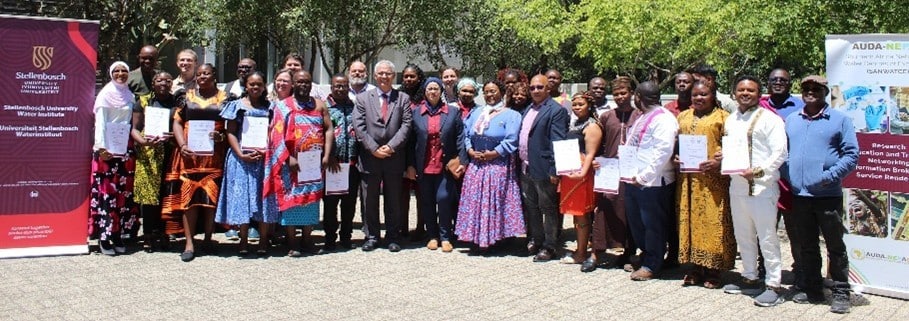
The African Union’s Semi-Arid Food Grains Research and Development (AU-SAFGRAD), in collaboration with the League of Arab States’ Fund for Technical Assistance to African Countries (AFTAAC) and the Stellenbosch University Water Institute (SUWI), organized training on Design, Operations and Maintenance (DOM) of climate-smart agricultural technologies. The training was organized as part of AU-SAFGRAD’s program support to build institutional capacity in AU Member States. African food systems are highly dependent on rainfed agriculture and have limited use of climate-smart agricultural (CSA) solutions. Against the backdrop of recurring climate variability, low production and productivity, increased episodes of hunger and malnutrition, and rising food import bills, these have become major economic outcomes for most economies on the continent. Dearth of high-level technical expertise, especially in public support institutions and agencies, has been identified as a key drawback in Member States’ ability to implement the Comprehensive African Agricultural Development Program (CAADP) Kampala Agenda with its laudable vision of Sustainable and Resilient Agrifood Systems for a Healthy and Prosperous Africa. The 12-day intensive training adopted a mixed mode of seminar lectures, field practicals, and farm visits. The target beneficiaries were young and early-career agriculture engineers and experts from public ministries, departments, and agencies (MDAs) responsible for irrigation and CSA solution support. Participants for the training were nominated from 14 Anglophone AU Member States (Botswana, Cameroon, Eswatini, Ethiopia, Kenya, Malawi, Namibia, Nigeria, Seychelles, Tanzania, Zambia, Zimbabwe and South Africa). The annual training serves as training for trainers (TfT), and it seeks to build the pool of technical experts on the continent. During the training, participants were exposed, among others, to DOM of greenhouses, hydroponics (aeroponics, aquaponics, deep water culture and nutrient film techniques), micro-irrigation, rainwater harvesting and use, fertigation, water laws, conflict management in shared natural resources, water quality and soil salinity management, conservation agriculture and precision farming. The fully residential training was held at Stellenbosch University, South Africa
African Union Commission was represented at the closing and certification ceremony by Dr. Ahmed Elmekass (Coordinator- AU-SAFGRAD), Dr. Mure Agbonlahor (Senior Officer- Production & Marketing) and Mr Issiaka Ouedraogo (Finance Officer) on Friday 20th November 2026. The closing remarks were delivered by Ms. Ntombizanele Bila–Mupariwa. Head of Department: Water and Sanitation, on behalf of the Minister of South Africa. Amb. Badreldin Ali Mohamed ElGuaifri, the Assistant Secretary General of the League of Arab States and DG AFFTAC, who was represented by Ms Sherine Emam, Minister Plenipotentiary, AFTAAC. The Dean, Faculty of Science, Prof. Burtram Fielding, was represented by Mr Manuel Jackson of Stellenbosch University Water Institute, as well as Dr Ahmed Elmekass, Coordinator, AU-SAFGRAD. In his closing speech, Dr Ahmed Elmekass emphasized the importance of scaling irrigation and agricultural water management solutions as climate adaptations in achieving the CAADP Kampala objectives and the goals of AU’s Agenda 2063.